
Tree Pruning, Crown Reduction or Thinning: What’s the Difference?
A simple guide to tree pruning terms and what they mean
If you are not sure whether your tree needs crown reduction, crown thinning, pruning back or something else entirely, don’t worry. You do not need to know the answer before contacting us.
In most cases, a few straightforward questions will help us understand the issue. Once we visit the site and see the tree properly, the right recommendation will become clear.
This guide simply explains the most common tree pruning terms, so you know what they mean if they appear in a quotation or work specification.
Pruning: the general term
Pruning is the broad term for selectively removing branches from a tree.
It can be done for several reasons, including improving clearance, reducing shading, removing unsafe branches, managing size or supporting the long-term health and shape of the tree.
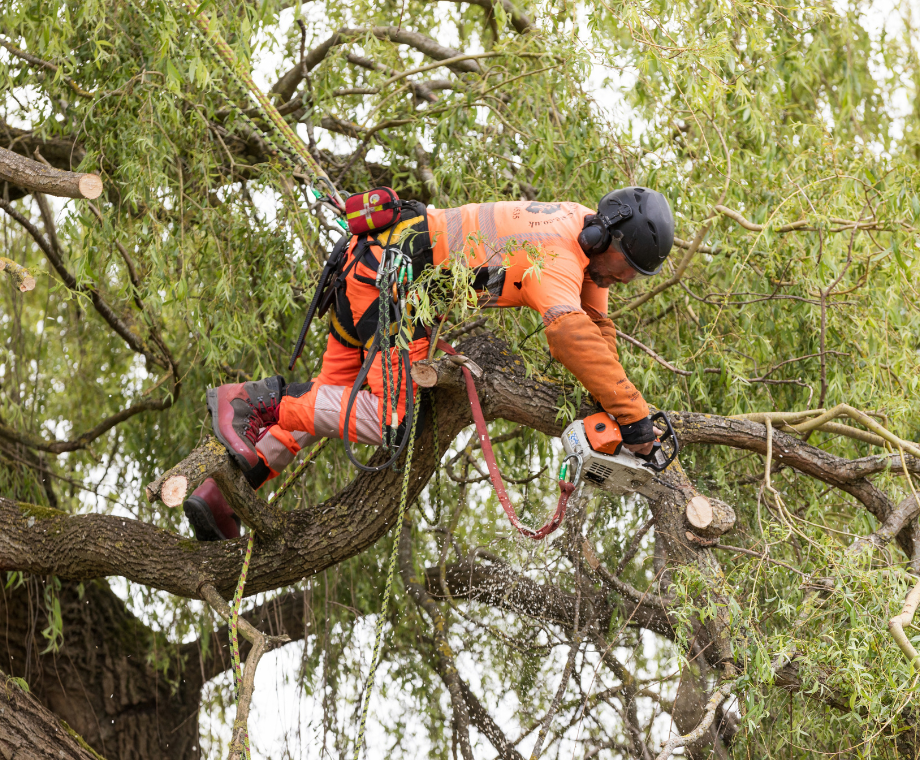
Good pruning is not just “cutting branches off”. Every cut affects the tree, so the work needs to be planned carefully and carried out by tree surgeons who understand tree growth, structure and species.
Crown reduction: making the tree smaller
Crown reduction reduces the height and/or spread of a tree’s crown while keeping its natural shape as much as possible.
It may be recommended where a tree has become too large for its setting, is close to a building, is causing excessive shading or needs weight reduced from parts of the crown.
A proper crown reduction should be measured and specified clearly. That way, everyone understands how much is being removed and what the finished tree should broadly look like.
Crown thinning: letting more light through
Crown thinning removes selected smaller branches from within the crown to create a lighter, more even canopy.
Unlike crown reduction, thinning does not usually make the tree smaller. The height and spread should stay broadly the same.
It can be helpful where a tree feels too dense, is casting heavy shade or would benefit from reduced wind resistance. It needs to be done evenly and sensitively, not by stripping out large areas of growth.
Crown lifting: creating clearance underneath
Crown lifting removes or shortens lower branches to raise the bottom of the crown.
This is often used where branches are blocking paths, driveways, roads, lawns, buildings or sightlines. It can also make a garden feel more open without reducing the whole tree.
On mature trees, crown lifting needs particular care. Removing large lower limbs can leave big wounds, so shortening selected branches may sometimes be the better option.
Pruning back: dealing with a specific problem
Pruning back usually means reducing selected branches rather than working on the whole crown.
This is common where branches are overhanging a neighbouring property, touching a roof, obstructing gutters, growing towards a building or interfering with access.
The aim is usually practical, such as to create space, prevent damage or deal with a particular nuisance while keeping the tree in good condition.
Deadwood removal: managing safety and habitat
Deadwood removal involves removing dead branches where they may present a risk.
Not all deadwood needs to be removed. In some locations, it provides useful habitat for wildlife. But dead branches over roads, paths, gardens, car parks, schools or buildings may need attention.
A professional arborist will consider both safety and environmental value before recommending what should be removed.
How arborists decide what tree work is needed
The right tree work depends on more than the phrase used to describe it.
We look at the tree’s species, age, condition, location, structure and surroundings. We also consider what the client is trying to achieve, whether that is more light, better clearance, less overhang, improved safety or long-term tree management.
Sometimes the answer is one type of work. Often, it is a combination, such as light crown lifting, pruning back from a building and removing hazardous deadwood.
That is why a site visit is so useful. It turns a general concern into a clear, practical recommendation.
Check before arranging tree work
Before any pruning is carried out, it is important to check whether the tree is protected by a Tree Preservation Order or located within a Conservation Area.
If consent is needed, the work must be approved before it starts. A professional tree care company can help check this and guide you through the process.
Professional tree pruning across the South East
Connick Tree Care provides professional tree maintenance services for homeowners, housing associations, local authorities, estates, schools and commercial clients across the South East.
Our experienced arborists can assess your tree, explain the options clearly and provide a written specification for the work required.
If you are unsure what your tree needs, just get in touch. We will ask the right questions, visit the site where needed and recommend the most appropriate approach.
